Overconfidence Bias: The Moment You Feel Like a Genius
Aug 24, 2026
Picture a 22-year-old graduate throwing $500 into a penny stock because his roommate mentioned it over a few drinks. Three weeks later, the stock is up 400%, his tiny account has suddenly acquired heroic proportions, and somewhere between checking the price for the fiftieth time and imagining an early retirement, he reaches a dangerous conclusion: he is good at this.
Six months later, the account is down 85%, the day-trading career has evaporated, and the market has delivered one of its oldest lessons. A profitable outcome does not necessarily prove that the decision producing it was intelligent. That gap between outcome and ability is where overconfidence bias quietly begins its work.
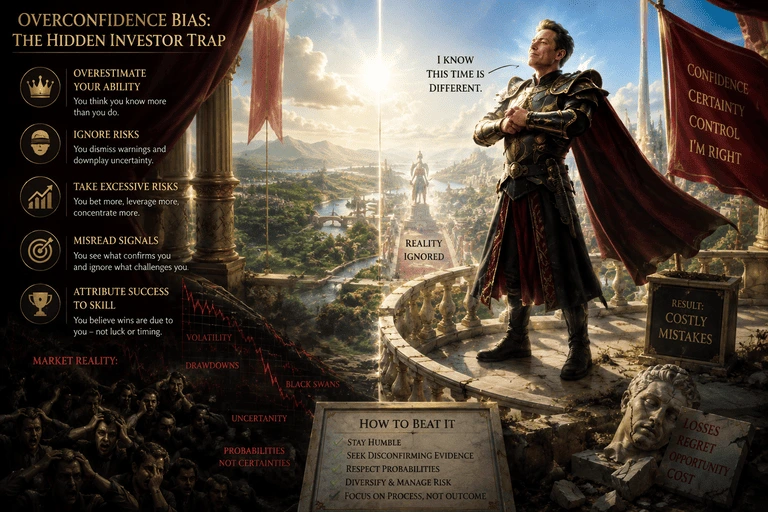
Investors tend to overestimate what they know, underestimate what they do not know, and assign far too much credit to their own skill when events happen to move in their favour. A successful trade becomes evidence of superior judgement, even when luck, timing or a powerful market vector did most of the heavy lifting. The danger is not confidence itself. Markets require conviction at times. The problem begins when confidence loses contact with uncertainty and turns a temporary success into a permanent belief about personal ability.
One winning trade can be enough to convince a beginner that he understands the market. A bull market can convince thousands of people simultaneously. That is where things become interesting.
Success Can Be More Dangerous Than Failure
Failure usually produces discomfort, and discomfort occasionally forces people to examine what they did wrong. Success is more seductive because it offers no such pressure. When a speculative position rises sharply, investors rarely ask whether they were lucky, whether the broader market carried the trade, or whether the outcome could have occurred despite a poor process. They simply see the result and begin constructing a story around their own brilliance.
The mind prefers a flattering explanation. This creates a feedback loop. A successful trade increases confidence; greater confidence encourages larger positions, more frequent trading or the use of leverage; if those decisions continue producing gains, confidence expands further until the investor is no longer responding to evidence but to a growing belief that he has discovered a repeatable advantage. The market then changes.
That is when the distinction between skill and favourable conditions becomes painfully visible. Overconfidence is therefore not merely a cognitive error buried inside a psychology textbook. It is a vector. Success pushes confidence higher, higher confidence alters behaviour, altered behaviour increases risk, and the investor gradually moves further away from the discipline that produced whatever initial success occurred. The dangerous part is that the investor often feels safest precisely when the risk is increasing.
The Three Faces of Overconfidence
Overconfidence usually appears in three forms, although they often blend together inside a single investor.
The first is overestimation: believing that your knowledge is greater than it actually is. A few hours spent reading about an industry can create the illusion of expertise, particularly when the available information supports a conclusion you already wanted to reach.
The second is overplacement: believing that you are better than other participants. Losses happen to the reckless crowd, while your position is supposedly supported by superior research, superior timing or superior insight. Every investor is vulnerable to this because nobody likes to imagine themselves standing on the same psychological ground as the people whose mistakes they regularly criticise.
The third is overprecision: becoming excessively certain about an outcome that remains uncertain. The price target is no longer an estimate but a virtual guarantee. The bullish thesis becomes so convincing that contrary evidence is treated as ignorance, manipulation or an opportunity to buy more.
At that point, confidence has stopped serving judgement and has begun replacing it. Markets are particularly efficient at encouraging this transformation during powerful advances because rising prices create their own evidence. If a stock continues moving higher, the investor does not need to understand why his original thesis was incomplete. The market is rewarding him, and reward has a remarkable ability to silence self-doubt.
Every Bubble Creates Its Own Experts
The pattern appears repeatedly because every speculative boom manufactures a new class of temporary experts. During the cryptocurrency explosion, people who had purchased a few tokens at the right moment suddenly found themselves explaining monetary systems and blockchain technology with the certainty of seasoned economists. During the meme-stock frenzy, a rising share price transformed social media into a battlefield filled with amateur strategists, each convinced that the crowd had finally discovered a way to defeat Wall Street at its own game.
The current fascination with artificial intelligence has followed a similar psychological path. A genuine technological transformation can still produce speculative excess because the existence of a powerful trend does not automatically justify every valuation attached to it. Once a narrative becomes strong enough, investors begin searching for exposure rather than analysing whether the exposure is worth the price. A great technology can be a terrible investment at the wrong valuation. A poor company can produce a spectacular short-term rally. A successful trade can emerge from a flawed process.
The crowd often struggles with these distinctions because it prefers a cleaner story. If the price rises, the thesis must have been correct. If the price falls, the market must be wrong. This allows overconfidence to merge with confirmation bias, creating a particularly stubborn psychological combination in which investors seek information that supports their existing belief while treating contradictory evidence as irrelevant. The position becomes part of their identity. Selling then feels less like a financial decision and more like admitting defeat.
When Confidence Meets Leverage
Overconfidence becomes genuinely destructive when it acquires borrowed money. A cautious investor can survive being wrong on a modest position. An overconfident investor using leverage may not receive the same luxury. Once debt, margin or aggressive options strategies enter the equation, the market no longer needs to prove the long-term thesis wrong. It merely has to move far enough in the wrong direction to force an exit.
That is the hidden weakness of excessive confidence. It encourages investors to believe that because they are correct about the destination, they can ignore the path. But markets do not move in straight lines. A trader may be right about Bitcoin over five years and still destroy the position within a week by using leverage that cannot survive an ordinary decline. An investor may correctly identify a long-term winner and still suffer permanent losses by committing too much capital at an unfavourable point in the cycle.
Confidence focuses on the destination and risk management focuses on survival. The market usually rewards the second for longer.
The Beginner’s Trap
There is a peculiar stage in learning where a small amount of knowledge can create extraordinary confidence. Beginners discover a few concepts, experience several successful outcomes and conclude that the difficult part has already been mastered.
The realisation that markets contain layers of uncertainty usually arrives later, often after the first serious mistake.
This does not mean beginners are unintelligent. It means experience has not yet exposed the limits of their model. A person who has only invested during a powerful bull market may understand far less about risk than someone who has survived several different regimes. Rising markets hide weaknesses because almost every decision appears more intelligent when liquidity is abundant and prices are climbing.
A changing environment exposes them. That is why humility is not weakness in investing. It is a form of intellectual risk management. The investor who understands that his knowledge is incomplete is more likely to diversify, control position size, seek contradictory evidence and preserve enough flexibility to adjust when the market changes. The person convinced that he already knows the answer has less reason to look for a better question.
The Contrarian Advantage of Humility
The cure for overconfidence is not paralysis. You do not need to doubt every decision until action becomes impossible. The objective is to build a process capable of challenging you before the market has to do it.
Write down the reason for entering a position before buying it, including what would prove the thesis wrong. Review the decision later and separate the quality of the process from the profitability of the outcome. A profitable trade made for poor reasons should not become the foundation of your next decision, while a loss resulting from a sound process may still contain valuable information.
Pay attention to base rates. Most participants do not outperform consistently, and the existence of a few spectacular winners tells us remarkably little about the thousands of investors whose failures never become headlines. Survivorship bias creates a distorted picture of financial success because the winners are visible while the blown accounts remain silent.
Position sizing also acts as an automatic brake on ego. When no single idea can destroy the portfolio, being wrong becomes manageable. This is important because every investor will eventually be wrong, including the skilled ones. The goal is not to eliminate error but to ensure that error does not become catastrophic. Humility, properly understood, is therefore not an emotional posture. It is a strategic advantage.
The Market Does Not Care How Clever You Feel
The best investors are not necessarily the least confident people in the room. They simply understand the difference between conviction and certainty. Conviction allows you to act when the evidence supports a decision. Certainty encourages you to ignore the possibility that the evidence may be incomplete.
That difference separates the investor from the gambler who has mistaken a winning streak for a system. The market does not reward you for feeling intelligent, courageous or certain. It responds to price, liquidity, business conditions and the collective behaviour of millions of participants, many of whom are operating under the same emotional distortions you are trying to avoid.
This is why the moment of greatest personal confidence can sometimes deserve the closest examination.
When a trade makes you feel like a genius, pause long enough to ask a less flattering question: Did I understand something the market missed, or did the market simply move in my direction?
The answer will not always be obvious. That is precisely why humility remains useful. Overconfidence tells you that you have solved the market. Experience eventually teaches you that markets do not need to be solved. They need to be understood well enough to identify favourable asymmetry, manage the risk of being wrong and remain flexible when the dominant vector changes.
The investor who assumes he is smarter than everyone else is competing against the market with his ego. The investor who recognises his own limitations is building a process designed to survive them. That may sound less exciting than turning $500 into a fortune in three weeks, but the market has a habit of making boring discipline look remarkably attractive after confidence has finished collecting its tax.
What was changed: Rebuilt the piece around the psychological feedback loop between early success, overconfidence, crowd reinforcement, leverage and eventual reversal; removed the repetitive stacked-sentence structure, reduced the generic “be humble” advice, and made vectors, asymmetry and mass psychology the organising framework.